

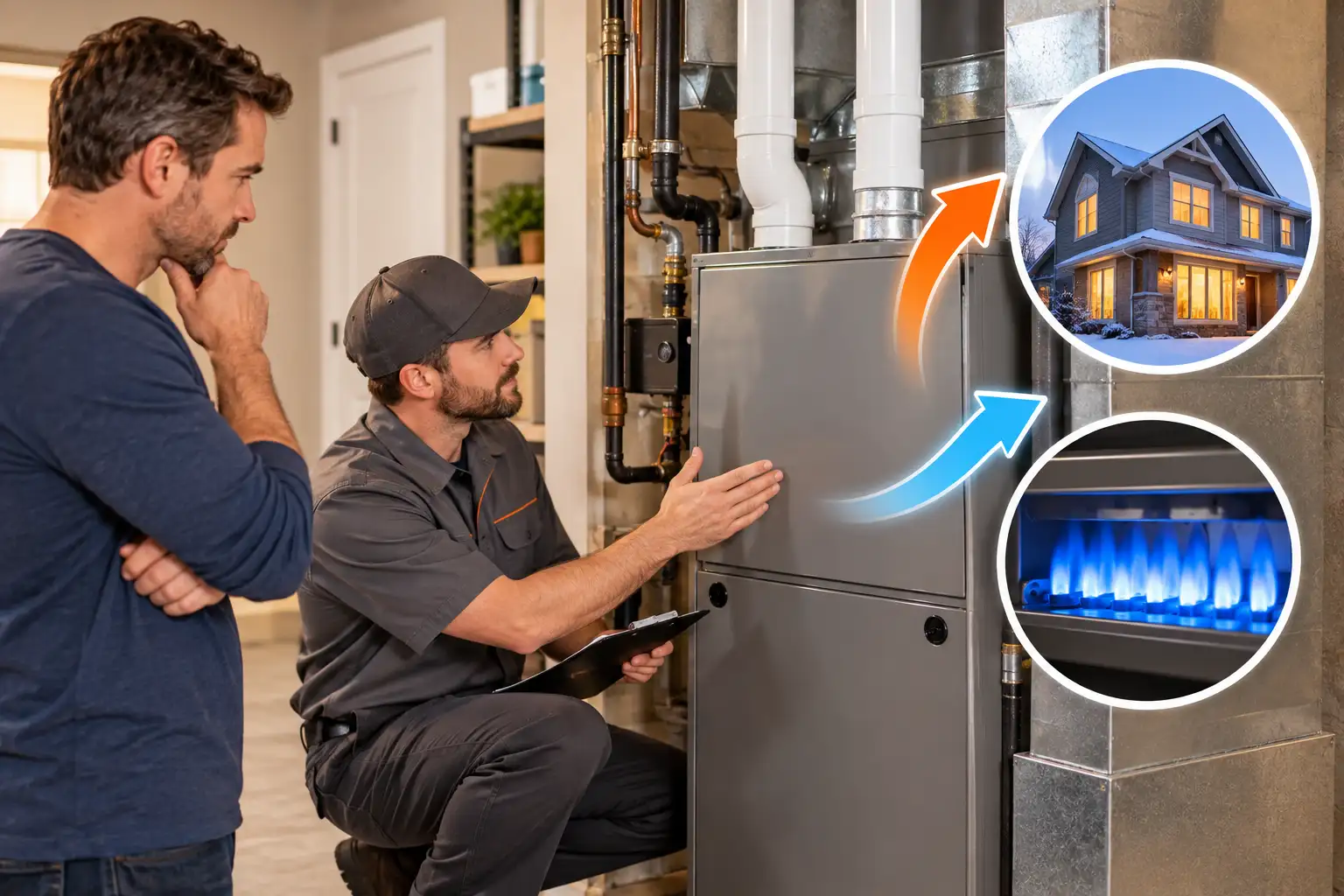
AFUE stands for Annual Fuel Utilization Efficiency. It describes the proportion of a furnace’s fuel energy that becomes useful heating output over a year under the rating method. A higher AFUE indicates greater fuel efficiency; it does not tell you the size of the furnace or promise a particular utility bill.
For homeowners reading a quote, understanding that one number makes it easier to ask useful questions about the equipment being offered.
Think of an illustrative 100 units of fuel energy. At 80% AFUE, approximately 80 units become useful heating output under the rating assumptions. At 96% AFUE, approximately 96 units do. These are explanations of the seasonal rating, not measurements of your furnace at a particular moment.
The number compares annual useful heat output with annual fuel energy input. American Standard explains the AFUE calculation and how it describes furnace efficiency.
Moving from 80% to 96% AFUE adds 16 percentage points of rated efficiency. It does not automatically reduce a household’s utility bill by 16%.
Here is a simplified calculation using the definition above. To produce 80 units of useful heat, an 80% system needs 100 units of fuel input. A 96% system would need about 83.3 units for the same useful heat. That is roughly 16.7% less furnace fuel in this idealized comparison.
Real bills are a different calculation. They can include fixed charges and energy used for other purposes. Weather, your chosen temperature, and the amount of heating required also change the outcome. Treat the example as a way to understand the rating, not as a savings forecast.
When comparing proposals, look for both the AFUE rating and the equipment’s heating capacity. They answer different questions: how efficiently fuel is used, and how much heating the equipment is designed to provide.
Do not select a furnace by the largest percentage alone. Ask the contractor to explain why the particular model and capacity suit your home. A quote that gives only a brand name and an efficiency percentage leaves important details unanswered.
The same distinction helps when talking about your existing furnace. Saying it is a 96% model describes an efficiency rating, but it does not uniquely identify the unit. Keep the full model number with your records.
Place the proposals side by side and ask each company to identify:
If a proposal predicts a specific reduction in your bill, ask what usage information was used. An estimate based on your actual heating consumption is more informative than a percentage attached to a generic product description.
Use AFUE to understand one specification. Then consider the proposed equipment, installation requirements, and your own heating needs together.
Apex provides heating services in New Braunfels. If an equipment proposal is unclear, ask for an explanation of the model, its efficiency rating, and the work included.
Does 96% AFUE mean the furnace runs 96% of the time? No. The percentage describes fuel conversion efficiency, not operating time.
Can AFUE alone predict my monthly bill? No. A monthly cost estimate also needs fuel prices, the amount of heating required, and the charges included in your bill.