


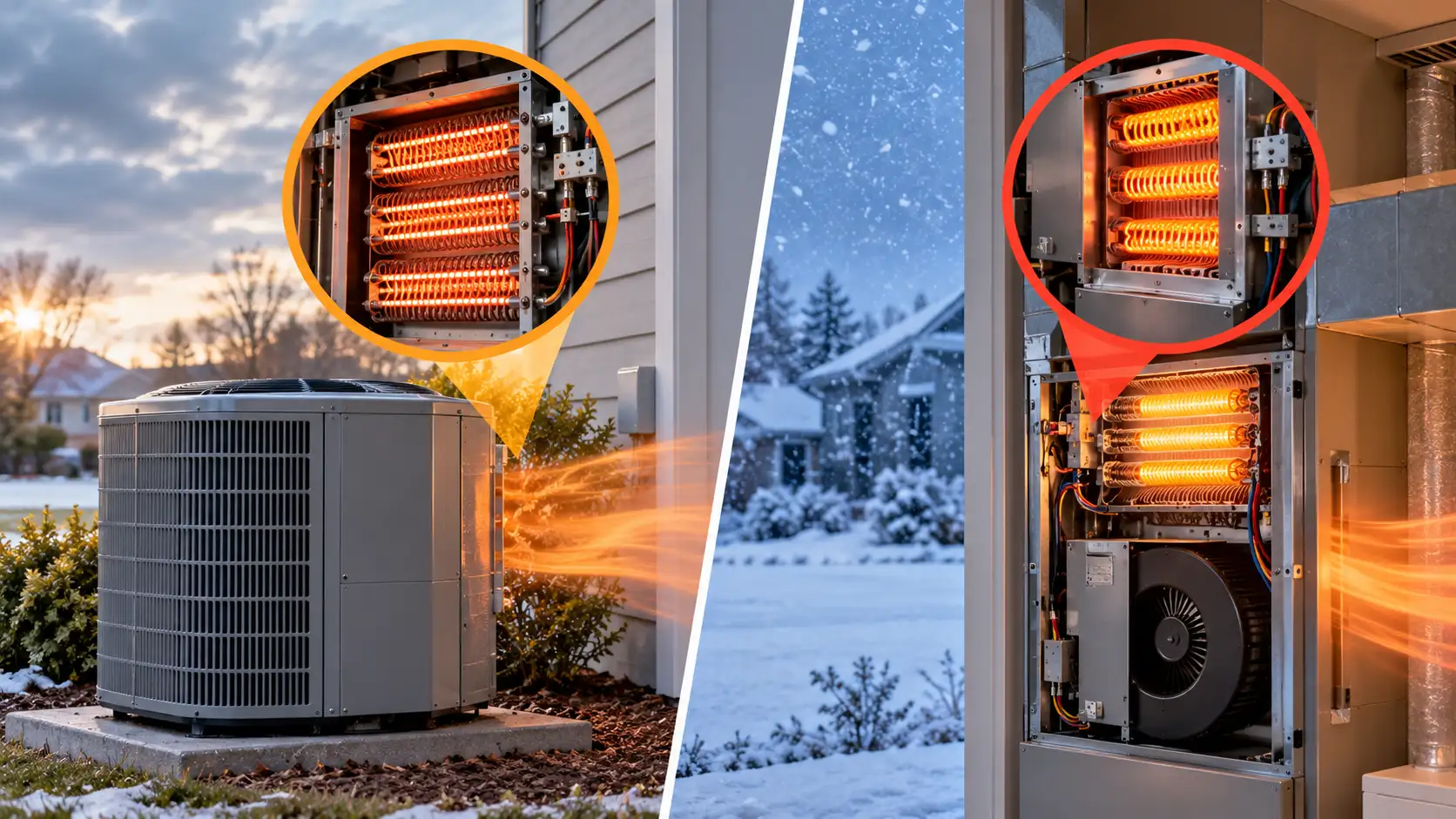
Auxiliary heat turns on automatically when your heating system needs backup. Emergency Heat is usually a setting you select manually when your heat pump is not working properly.
These terms commonly appear on thermostats connected to heat pumps with a backup heating source. Seeing “AUX” does not automatically mean something is wrong, while selecting “Emergency Heat” changes how your system operates.
For New Braunfels homeowners, understanding these settings can help you stay comfortable and avoid unnecessary heating costs.
| Feature | Auxiliary Heat | Emergency Heat |
| How it starts | Automatically when the system needs backup heat | Usually selected manually on the thermostat |
| Main purpose | Helps meet the home’s heating demand | Provides temporary heating when the heat pump is unavailable |
| Heat pump operation | May continue running, depending on the system | The heat pump compressor is normally bypassed |
| Typical use | Can be part of normal heating operation | Used during a heat pump malfunction or as directed by a technician |
Both modes may use the same backup heating equipment. Many systems have electric heating elements called heat strips. Others use a backup furnace. In a heat pump and furnace combination, the furnace may take over heating instead of running alongside the heat pump.
Auxiliary heat, often displayed as AUX Heat, provides additional heating when the heat pump alone is not meeting the system’s needs.
It may come on when:
The exact triggers depend on your equipment and thermostat settings. There is no single outdoor temperature at which every heat pump needs auxiliary heat.
Emergency Heat, sometimes labeled EM Heat or E Heat, allows a compatible system to heat your home using its backup source while bypassing the heat pump.
It may be appropriate when the heat pump has failed and you need temporary heating while arranging repairs. Follow your equipment’s operating instructions and contact an HVAC professional if you are unsure whether to use it.
A cold forecast alone is not a reason to select Emergency Heat. Leave a functioning system in its normal heating mode so its controls can manage backup heat when needed.
Emergency Heat does not repair the heat pump. If you need to rely on it regularly, have the underlying problem checked.
When the backup source uses electric heat strips, it generally takes more electricity to produce the same amount of heat than a properly operating heat pump.
Both auxiliary heat and emergency heat can therefore increase electricity use. Emergency Heat can be particularly expensive when it supplies all the home’s heating for an extended period.
However, the thermostat label alone does not determine the cost. Your bill depends on the backup heat source, how long it runs, the amount of heat needed, and local energy prices. A system with a backup gas furnace has a different cost comparison from one using electric heat strips.
Auxiliary heat can run longer when heating demand is high. A brief AUX message during a cold period or defrost cycle can be normal.
An inspection is worthwhile if:
A technician can check whether the controls are calling for backup heat appropriately and whether the heat pump is operating correctly.
Avoid repeatedly making large thermostat increases. Depending on the controls, recovering from a much lower temperature can bring on electric backup heat.
A compatible heat pump thermostat with adaptive recovery can warm the home gradually before a scheduled temperature change, helping reduce unnecessary auxiliary heating. Ask your technician which scheduling approach suits your system.
Do not change installer settings or disable backup heating simply to stop the AUX indicator. These settings need to match the equipment and your home’s heating requirements. Have a qualified technician review them if backup heat seems excessive.
Apex Electrical, A/C & Heating LLC provides heating and heat pump services in New Braunfels and surrounding communities.
If your thermostat keeps showing AUX or your home depends on Emergency Heat, contact Apex to schedule a heating inspection. We can assess the system and explain what needs attention.